
Trees
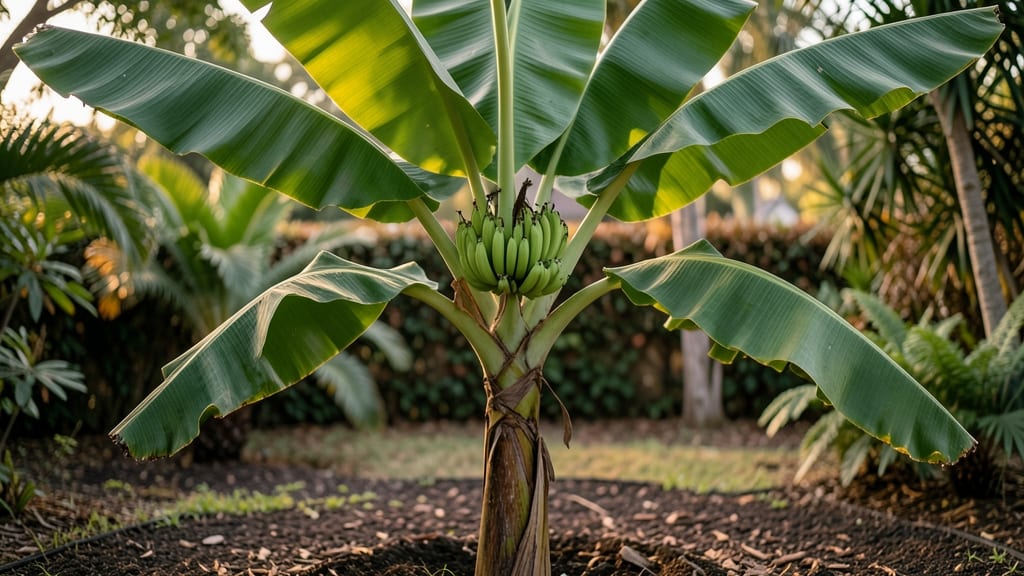
Banana trees produce fruit after reaching 9–18 months old, depending on variety, with dwarf varieties fruiting earliest and larger types taking up to 3 years. Warm climates (75–85°F) and consistent moisture accelerate fruiting, while cold or drought delays it. A single tree yields 1–2 bunches per year once mature.
Timing for banana fruit production depends heavily on the plant's genetics and growing conditions. Dwarf varieties like 'Lady Finger' can bear fruit in as little as 9 months, while commercial Cavendish types often take 2-3 years to reach maturity.
The key biological trigger is the development of a pseudostem—the tree's trunk-like structure—that must fully mature before flowering occurs. 🌱 What many growers don't realize is that even within the same variety, factors like soil fertility and daylight hours can shift fruiting by several months.
Once established, banana trees follow a predictable growth cycle: leaf production phases, followed by the emergence of the 'hand' (the flower cluster that becomes fruit). The transition from vegetative growth to flowering is particularly sensitive to temperature fluctuations—dropping below 60°F can permanently halt fruiting.
This is why tropical regions consistently produce better yields than temperate climates.
💡 In This Article
- Banana Tree Growth Stages to Fruit Production
- Optimizing Banana Tree Conditions for Faster Fruit
Banana tree growth stages to fruit production
Banana trees undergo a fascinating biological progression before producing fruit, beginning with the emergence of their iconic large leaves. Each leaf unfurls in a spiral pattern from the center, and the tree typically produces 10-15 leaves before reaching the fruiting stage.
The pseudostem—composed of tightly packed leaf sheaths—gradually thickens as the plant stores energy. This phase lasts 6-12 months, depending on the variety, with dwarf types completing it faster due to their smaller stature and accelerated metabolism.
The critical transition occurs when the pseudostem reaches 4-6 feet tall, signaling the plant's readiness to flower. Inside the pseudostem, a specialized bud called the "heart" begins developing into the inflorescence, or "hand." This process is highly sensitive to temperature, with optimal flowering occurring between 75-85°F.
Below 65°F, the flower bud may fail to emerge entirely, while temperatures above 90°F can cause premature fruit drop. The flower cluster emerges from the pseudostem's base, protected by a sheath that eventually unfurls to reveal the tiny flowers that will develop into bananas.
Variety plays a dramatic role in timing—dwarf 'Lady Finger' bananas may produce their first "hand" in 9-12 months, while commercial Cavendish varieties often take 2-3 years to reach this stage. Plantains, which are larger and starchier, typically require 18-24 months due to their more robust growth requirements.
The key difference lies in their genetic programming: dwarf varieties prioritize rapid reproduction over size, while commercial types invest energy in larger fruit clusters at the expense of speed.
What's often overlooked is how sunlight duration affects this process. Banana trees need 10-12 hours of direct sunlight daily to properly photosynthesize and store energy. In regions with shorter daylight (like northern latitudes), growers sometimes use supplemental lighting to maintain the 12-hour photoperiod critical for flowering.
This explains why tropical regions near the equator consistently produce fruit year-round, while temperate climates may see only 1-2 harvests annually.
The final stage involves the development of the fruit cluster, where each flower transforms into a banana. Initially, the bananas grow upward, then bend downward under their own weight—a process called "hanging" that takes 2-3 months.
During this time, the fruit undergoes rapid cell division, with the peel changing from green to yellow as chlorophyll breaks down and carotenoids emerge. The tree's energy output peaks during this phase, making proper nutrition absolutely critical for quality fruit development.
Interestingly, banana trees produce fruit only once in their lifecycle before dying—this is why commercial growers maintain multiple trees in staggered planting schedules. The mother plant's energy reserves are completely expended supporting the fruit, leaving no energy for future growth.
This biological limitation is why understanding these growth stages helps growers plan for continuous harvests by maintaining a rotating crop system.