
Flowers
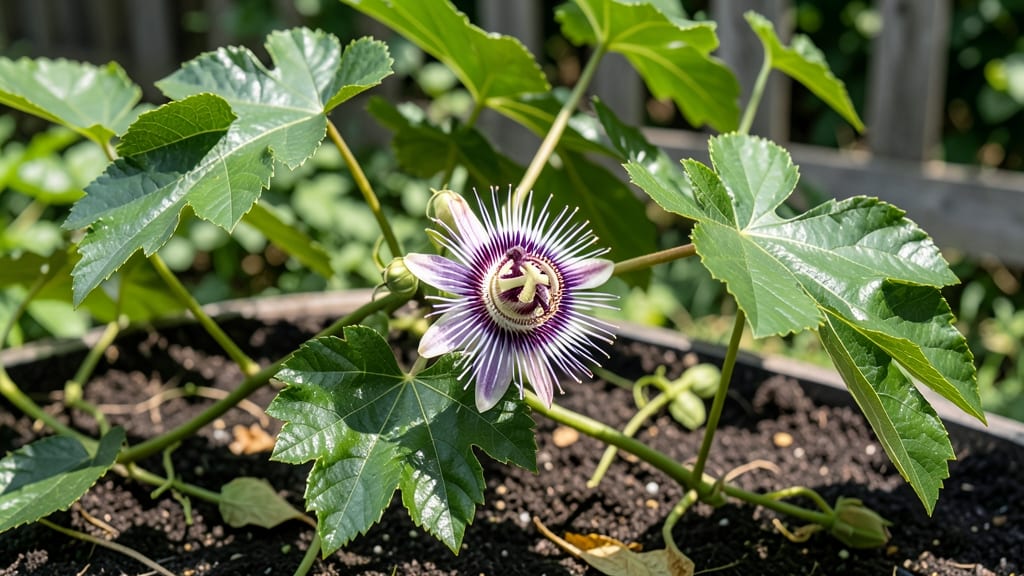
Passion fruit flower pictures showcase their dramatic beauty with vivid purple, blue, or white blooms featuring intricate tubular shapes and bold stamens. These captivating flowers are prized for their unique botanical details that attract both gardeners and photography enthusiasts.
These stunning blooms often feature a striking corona of thread-like filaments surrounding the central reproductive parts, creating a mesmerizing visual effect. 🌸 The Passiflora edulis variety, for example, typically displays deep purple petals with a complex internal structure, while Passiflora caerulea showcases delicate blue-white flowers.
Photographers love capturing their intricate details, especially when backlit to highlight the translucent petal edges and contrasting stamens.
What makes these flowers so photogenic is their three-dimensional texture—the raised corona filaments and intricate ovary placement create depth that's perfect for macro photography.
I always recommend shooting during golden hour to enhance the natural colors and reduce harsh shadows, while using a macro lens (100mm or longer) to capture every delicate filament. Post-processing with slight contrast adjustments can further emphasize their natural beauty.
💡 In This Article
- Identifying Passion Fruit Flower Species Through Visual Traits
- Best Photography Tips for Capturing Passion Fruit Flowers
Identifying passion fruit flower species through visual traits
The most reliable way to distinguish passion fruit flower varieties starts with their petal color and structure. For instance, the Passiflora edulis (purple passion fruit) displays deep magenta to violet petals with a dark purple corona—those thread-like filaments surrounding the reproductive center.
In contrast, Passiflora caerulea (blue passion flower) features pale blue to white petals with a white corona, creating a striking visual contrast.
The key difference lies in how these filaments are arranged: edulis has denser, more clustered filaments, while caerulea exhibits longer, more delicate strands that fan outward. 🌸
Examine the stamen and pistil arrangement for even clearer identification. The Passiflora edulis flower has five prominent stamens with yellow-tipped anthers, while the Passiflora caerulea displays three to five stamens with white or pale yellow anthers.
The ovary placement also varies—the edulis ovary sits below the petals (hypogynous), while caerulea often has a slightly elevated ovary (hemiepigynous). These structural differences become especially visible when you photograph the flowers from a side angle, revealing their unique botanical architecture.
Growth patterns offer additional clues. Passiflora edulis typically grows as a woody vine with lobed leaves and produces flowers on new growth, often near leaf axils. Meanwhile, Passiflora caerulea thrives as a hardy perennial vine with smooth, oval leaves and flowers that emerge from terminal buds.
The leaf shape alone can help—edulis leaves resemble maple leaves, while caerulea leaves are more elliptical with serrated edges. These visual distinctions make it easier to identify species even from a distance or in photographs.
For photographers, capturing these details requires attention to macro photography techniques. Focus on the corona filaments first—they create a halo effect when backlit, making them stand out against the petals.
Use a macro lens (100mm or longer) to isolate individual filaments, which can be as thin as 0.5mm in diameter. The stamens should also be in sharp focus, as their color contrast (yellow vs. white) helps distinguish species.
A reflector can help balance lighting when shooting in shaded areas, ensuring the translucent petal edges remain visible without overexposure. 💫
Advanced identification involves examining the fruit development after flowering. Passiflora edulis produces oval, purple-skinned fruits with sweet pulp, while Passiflora caerulea yields rounder, yellow fruits with a tart flavor.
This connection between flower and fruit is why botanists often study both stages together—it reinforces the visual traits observed in the blooms. For example, the number of corona filaments often correlates with the number of seeds in the resulting fruit, creating a fascinating link between form and function.
One common mistake is confusing Passiflora edulis with Passiflora ligularis (banana passion fruit). The latter features yellow petals and a bright yellow corona, along with longer, banana-shaped fruits. Comparing side-by-side images of these traits can help avoid misidentification.
Always photograph the entire flower and surrounding foliage to capture these contextual clues—this holistic approach ensures accurate species identification, whether for gardening or artistic purposes. ✨