
Fertilization
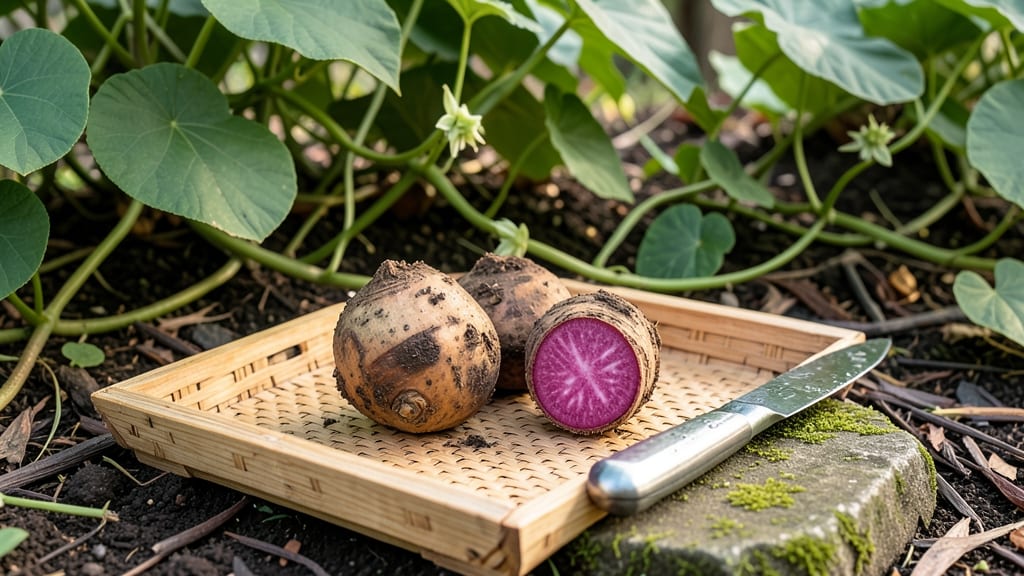
Ube isn't classified as a fruit—it's a vibrant purple tuber root from the yam family (Dioscorea alata) that's widely used like fruit in sweet dishes worldwide.
Botanically, ube belongs to the same family as sweet potatoes and regular yams, but its growth cycle sets it apart. 🌱 Instead of developing from a flower's ovary like true fruits, ube grows as an underground storage organ that stores nutrients for the plant.
This makes it a root vegetable rather than a fruit, despite its frequent use in desserts where it mimics fruit's natural sweetness and vibrant color.
What makes ube so versatile in cooking is its naturally sweet, slightly vanilla-like flavor when cooked. Many recipes treat it like fruit—think of how you'd use sweet potatoes or beets in pies or ice cream.
The key difference is in preparation: ube requires peeling and boiling before it can be mashed or pureed, unlike fruits that can often be used raw or with minimal prep.
💡 In This Article
- Botanical Classification: Why Ube Isn’t a Fruit
- Culinary Uses of Ube: How It Functions Like a Fruit
Botanical classification: why ube isn’t a fruit
Ube belongs to the Dioscorea family, which includes over 600 species of yams—none of which are true fruits. The key difference lies in how plants produce them: fruits develop from a flower's ovary and contain seeds, while ube grows as an underground tuber that stores energy for the plant.
This tuber formation is similar to potatoes or sweet potatoes, which also belong to different botanical categories despite their culinary similarities.
The confusion often arises because ube's vibrant purple flesh and sweet flavor mimic fruits like beets or sweet potatoes. However, botanists classify it as a monocotyledon (like lilies), while most fruits are dicotyledons.
Its starch content (around 20-25% by weight) further distinguishes it from fruits, which are typically lower in starch and higher in water content. 🌱 The tuber's growth starts from a shoot that develops into a swollen underground stem, not from reproductive structures.
What makes this classification important is how it affects nutrition. Fruits provide vitamins, fiber, and natural sugars, while ube offers complex carbohydrates and antioxidants like anthocyanins (which give it its color).
The tuber's cell structure—dense and compact—means it doesn't break down like fruit flesh when cooked, requiring different preparation techniques to achieve a similar texture in desserts.
Consider this comparison: an apple (fruit) has seeds inside its flesh, while ube's "seeds" are actually the fibrous strands you might find when peeling it—a remnant of its growth pattern, not reproductive biology.
This structural difference explains why ube can't be used raw like many fruits; its high starch content would make it unpalatable without cooking to soften the cells.
The term "purple yam" sometimes appears in Western markets, but this is a culinary simplification. Botanically, true yams (like Dioscorea cayenensis) are entirely different—often brown-skinned and less sweet.
Ube's unique classification as a tuber explains why it behaves differently in recipes, requiring boiling or steaming to develop its signature creamy texture and sweetness.
For those curious about the science, ube's tuber formation is a survival adaptation. When the plant's aerial parts die back, the tuber remains dormant underground, releasing stored nutrients when conditions are favorable.
This contrasts with fruits, which rely on animals to disperse seeds. The energy stored in ube's cells is what gives it its dense, satisfying mouthfeel in desserts like halaya.